
Jim Hogg County Court Records After Arrest
An arrest in Jim Hogg County usually starts with booking at the jail, then first appearance or magistration, bond review, and prosecutor screening. The 229th Judicial District Attorney handles felony prosecution for Jim Hogg County. The district attorney's official page lists Gocha A. Ramirez and explains that county and district attorneys represent the state, work with law enforcement in case preparation, and decide whether prosecutions will be instituted.
Booking information belongs to the jail side. Filed charges, cause numbers, hearings, motions, attorney entries, and dispositions belong to the court side. For custody and booking details, use Jim Hogg County jail inmate records. For booking photos, use Jim Hogg County jail mugshots. Court records after a jail arrest are tracked through the clerk, district court, posted dockets, and prosecutor filings.
Find Jim Hogg County Court Records
Texas does not have one single statewide court-records database for every local criminal case. The Texas State Law Library guide cited in the research says each court is responsible for its own records. In Jim Hogg County, the county site links an official records portal, but the visible Quick Search is for official or property records and is not confirmed as a criminal case database. Posted district criminal docket PDFs are the strongest online sample found for jail cases.
- Confirm custody or release status with the Jim Hogg County Sheriff's Department.
- Ask for the booking charge, bond, court, and cause number if releasable.
- For felony matters, check the 229th District Court and County and District Clerk.
- Review posted district criminal docket PDFs when available, especially jail-case settings.
- Call the clerk at (361) 527-4031 for file searches, copies, older records, or records not online.
- Contact the district attorney for prosecution status, not legal advice.
The County and District Clerk is Zonia G. Morales. The clerk office is at 102 E. Tilley / P.O. Box 878, Hebbronville, TX 78361, with office phone (361) 527-4031 and fax (361) 232-5875. The published office hours are Monday through Friday except holidays, 9:00 a.m. to noon and 1:00 p.m. to 5:00 p.m.
Jim Hogg County Court Search Fields
The official records portal visible in the research is useful for understanding county record access, but it should not be described as a confirmed criminal-case search. Its Quick Search form is tied to official or property records. Criminal court records after a jail arrest may require the clerk, docket PDFs, or direct court contact.
| Field Label | Type | Required | Options / Notes |
|---|---|---|---|
| Official Records Search Department | Dropdown or selector | Unspecified | Visible value: Property Records. Not confirmed criminal case search. |
| Search Term | Text | Optional or unspecified | Grantor/grantee, subdivision, document type, or document number. |
| Date Range | Date inputs | Optional | To and from recorded dates. |
| Recorded Date presets | Filter links or buttons | Optional | Last 24 hours through last 1 year. |
| Search scope | Radio buttons | Optional | Search Index Only or Search Index and Full Text OCR. |
Jim Hogg County Jail Case Dockets
The official February 3, 2025 district criminal docket PDF is a useful sample for court records after a jail arrest. It identifies the 229th District Court, Judge Baldemar Garza, a 9:00 a.m. docket time, and a jail-case docket category. Sample cause number formats include entries like 17-CRJ-24 and 23-CRJ-47. Styles use State of Texas versus the named defendant.
The docket also shows settings and notes, including announcement settings, state's motion to adjudicate guilt, motion to revoke pre-trial bond conditions, trial date notes, prosecutor entries, and defense counsel columns. A docket is not the full case file, but it gives a public roadmap for what court records exist after the arrest.
The 229th District Court page identifies Judge Baldemar Garza and court staff for Jim Hogg, Starr, and Duval County.
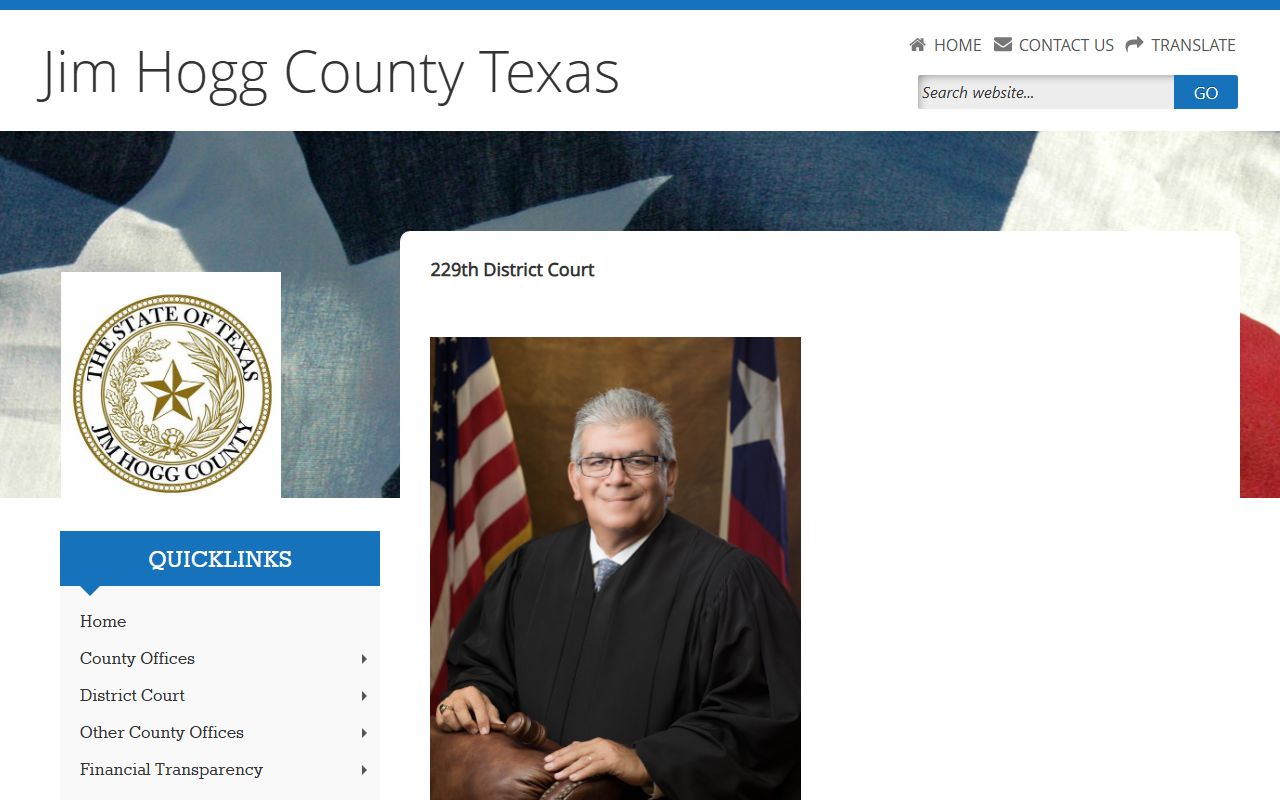
The district court source helps route felony jail cases after the initial booking and bond stage.
Charges Filed After Arrest
A booking charge is an arrest-side label. A filed charge is the court-side accusation that the prosecutor places into a case. Prosecutors may change, add, reduce, or decline charges after reviewing reports. For Jim Hogg felony matters, the 229th Judicial District Attorney is the key prosecution office. For lower matters, county or justice-court routing may apply based on charge level.
| Document | What It Means | Common Use |
|---|---|---|
| Complaint | A sworn charging document often used early in the criminal process. | Early case filing or misdemeanor context. |
| Information | A prosecutor-filed charging document. | Many non-indictment cases. |
| Indictment | A grand-jury felony charging document. | Felony cases requiring grand-jury action. |
The district attorney's office is at 102 E. Tilley, Suite 206, Hebbronville, TX 78361, with mailing address P.O. Box 340. The official page lists phone (361) 527-4056 and fax (361) 527-4032.
Jim Hogg County Charge Status
Court records after an arrest can change as the case moves. A pending charge is unresolved. An amended or reduced charge means the prosecutor changed the filing. A dismissed charge ends without a conviction on that charge. A motion to revoke or motion to adjudicate means the state is asking the court to act on supervision or deferred-adjudication terms. A conviction is a final adjudication or plea, not the arrest itself.
| Status | Meaning | Where It May Appear |
|---|---|---|
| Pending | Filed and unresolved. | Clerk file or docket. |
| Amended or reduced | Prosecutor changed the charge. | Case filings or docket entries. |
| Dismissed | Charge ended without conviction. | Order, docket, or disposition record. |
| Motion to revoke | State alleges a supervision or bond-condition violation. | District criminal docket or motion. |
| Conviction | Final adjudication or plea result. | Judgment or disposition record. |
Bond Records After Arrest
Texas Code of Criminal Procedure Article 17.15 governs bail factors. In plain terms, bail should assure court appearance, should not be used as oppression, and may account for the offense, circumstances, ability to make bail, and future safety of the victim or community. The Jim Hogg sheriff page says the sheriff accepts bail for prisoners in custody and, in a county without a bail bond board, sets bail bond policy. No Jim Hogg County online bond-payment link or jail bond schedule was located.
| Bond Type | How It Works Locally |
|---|---|
| Cash bond | Confirm with the sheriff which office accepts payment, required ID, payment types, and hours. |
| Surety bond | A licensed bail bond company posts a surety bond, if accepted for the charge. |
| Personal bond | Release on written promise, if ordered by the court or magistrate. |
| No-bond or hold | A warrant, parole hold, ICE detainer, federal hold, or other agency hold may block release. |
Certified Payments appears on the clerk page, but the research warns not to label that as a jail bond or inmate-deposit path unless a local office confirms it.
Warrants and Court Records After Arrest
No official Jim Hogg County sheriff active-warrant search, warrant list, most-wanted page, or mobile warrant app was located. The Justice of the Peace page states that a justice of the peace may issue search and arrest warrants and conduct preliminary hearings. Warrants can also come from district or county court as bench warrants, capias matters, probation or community-supervision issues, and lower-court citation matters.
For warrant-related custody questions, call the sheriff at (361) 527-4140. For lower-level JP matters, the Justice Court page lists the court at 133 East David Street, Hebbronville, TX 78361 and Precinct 1 phone (361) 527-5830. For district or county criminal case records, call the clerk at (361) 527-4031.
Charges vs Convictions
An arrest is not proof of guilt. A charge is an accusation filed or carried forward in court. A conviction is the final court result after a plea, finding, or verdict. Court records after a jail arrest should be read by stage, because a booking charge may never become a conviction, and a filed charge may later be reduced or dismissed.
| Issue | Charge | Conviction |
|---|---|---|
| Stage | Accusation or filed count. | Final adjudication, plea, or verdict. |
| Proof | Lower threshold at early stages. | Resolved under criminal burden and court process. |
| Record source | Complaint, information, indictment, docket. | Judgment, sentence, disposition. |
| Effect | May change or be dismissed. | Can affect sentence, supervision, and later records. |
Sealed and Expunged Arrest Records
Texas law gives some people a path to clear qualifying arrest records. Expunction is the term used in Texas Code of Criminal Procedure Article 55.01 for qualifying arrests and outcomes. The research did not locate a Jim Hogg County local expunction packet, so the practical route is court-specific: review eligibility, identify the court, and file through the proper clerk or seek legal advice from a lawyer.
| Record Treatment | Plain Meaning | Jim Hogg County Route |
|---|---|---|
| Public record | Available unless an exception, seal, or expunction applies. | Clerk or sheriff request, depending on record type. |
| Sealed or restricted | Hidden from many public searches, but not erased for all purposes. | Court order required. |
| Expunged | Qualifying arrest records may be destroyed or treated as removed under court order. | Proceed through the court and clerk. |
Restricted Jim Hogg County Court Records
Texas public-information law supports access to public records, but it also recognizes limits. Juvenile matters, active investigations, medical details, victim information, confidential witness information, sealed records, expunged matters, security-sensitive jail information, and some law-enforcement records may be withheld or redacted. Section 552.108 is a common law-enforcement exception, while basic arrest information remains an important public category.
Important: This website is not a consumer reporting agency, and court or jail information may not be used for FCRA-covered screening decisions.